What to Look When Buying a Projector? Here Is the Answer
Learn what to look when buying a projector in November 2026, focusing on key resolution specs, throw distance, lumens, audio, and smart connections.
 By Ben Carter
Published

Choosing the right display setup comes down to balancing room brightness, throw distance, native resolution, and connectivity for your media devices. Evaluating these core hardware traits prevents common pitfalls like blurry images or washed-out colors in daylight. When determining what to look when buying a projector, you need to match the technical specifications directly to your room layout rather than relying solely on marketing claims. Taking a few measurements before shopping ensures the device fits your wall or screen space properly.
Ambient light control plays an equally vital role in how clear your picture looks during regular movie nights or gaming sessions. If you plan to use your equipment outside after dusk or in a dedicated theater, our outdoor projector brightness guide explains how lumen output impacts screen clarity. Understanding contrast, audio output, and physical placement flexibility will help you pick a model that delivers reliable performance without unexpected installation headaches.
| Award | Product | Best Projector Reviews Score About Best Projector Reviews ScoreBest Projector Reviews Score is a comparison aid based on available product information, not a hands-on testing result. Read our review methods. | |
|---|---|---|---|
| Best Overall |
 Yaber T1 Pro2 Mini Projector with WiFi |
8.3/10 | Buy |
| Best Budget |
 Littleluma Book Projector |
7.8/10 | Buy |
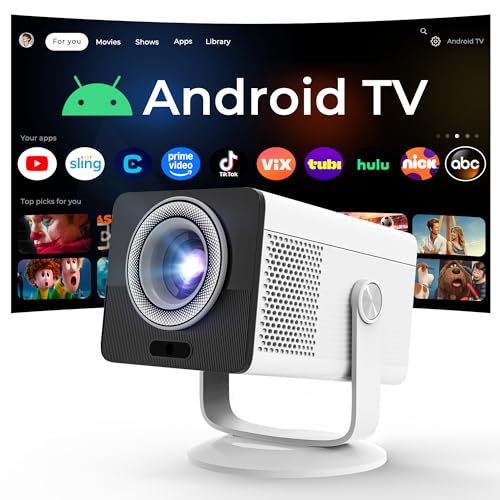 HP Projector Built-in Apps |
7.8/10 | Buy |
Essential Specifications and Features to Evaluate Before Buying
Selecting a projector requires examining several measurable hardware capabilities to ensure the projected image remains sharp, bright, and proportioned correctly for your space. Buyers often struggle when a device lacks adequate brightness for their room or when the throw ratio forces an awkward physical placement. Sorting through native resolutions, lens adjustments, and input options allows you to identify the right model for your specific entertainment needs.
| Feature Category | Specification Benchmark | Primary Practical Benefit | Ideal Usage Scenario |
|---|---|---|---|
| Native Resolution | 720p HD to Native 1080p FHD | Crisp text and clear high-definition detail | Movies, streaming shows, and casual gaming |
| Throw Ratio | 0.9:1 short throw up to 1.5:1 standard | Large image size within limited room depth | Small bedrooms, dorms, and compact apartments |
| Light Source Lifespan | LED or Solid-State Light Engine | Low maintenance without frequent bulb swaps | Daily streaming and regular nighttime viewing |
| Wireless Streaming | Wi-Fi 6 and Bluetooth 5.4 | Fast playback and low-latency audio pairing | Cord-free streaming and external speaker links |
| Adjustment Tools | Auto Focus and 4-Point Keystone | Quick geometric image alignment on uneven walls | Angled placement, bedside stands, and ceilings |
Keep this quick inspection checklist in mind when evaluating any potential projection equipment:
- Check the true native resolution rather than relying solely on maximum supported input signals.
- Measure the distance from your intended mounting surface to the screen to confirm throw ratio.
- Verify the physical input ports match your existing gaming consoles, laptops, and streaming sticks.
- Assess built-in audio decibels and speaker wattage to decide if external soundbars are necessary.
- Inspect lens adjustment options like electronic focus, optical zoom, and automatic keystone correction.
- Confirm power supply requirements if you intend to run the device from portable power banks.
Native Resolution Versus Supported Input Signals
Marketing materials frequently highlight terms like 4K support on units that actually feature a lower physical display chip. Native resolution describes the exact physical pixel grid inside the projection engine, such as 1280×720 or 1920×1080 pixels. A unit with 1080p native resolution renders high-definition content with authentic optical clarity, keeping fine details and small subtitles easily legible. In contrast, supported resolution simply means the internal processor can accept a high-resolution video signal and downscale it to the lower hardware display capability.
Choosing a native 1080p model prevents softness and pixelation, especially when projecting onto screens measuring eighty inches or wider. Budget-friendly models often feature native 720p resolution, which remains functional for children’s bedtime stories, animated films, or compact bedroom viewing. However, pairing a low native resolution device with a massive projection area makes individual pixels visible, degrading overall picture fidelity. Always verify the stated native physical pixel count in the specification sheet before committing to a purchase.
Video processing chips also handle dynamic range encoding like HDR10, which optimizes brightness gradients across dark and bright scenes. While a compact projector cannot produce the blinding specular highlights of a premium television, HDR compatibility ensures shadow detail is not entirely crushed in dark movies. Balancing your native pixel expectations with realistic room lighting ensures you get a clean picture without paying for unnecessary marketing buzzwords.
Throw Ratio, Room Dimensions, and Image Sizing
Throw ratio dictates how wide of an image the projector produces relative to its physical distance from the display surface. A standard projector typically features a throw ratio between 1.2:1 and 1.5:1, requiring substantial distance to create an expansive picture. Conversely, a short-throw design with a 0.9:1 ratio can cast an eighty-inch image from just over five feet away. Knowing your exact wall-to-lens measurement helps prevent purchasing a unit that creates an image too large or too small for your wall space.
Compact living quarters, dorm rooms, and small bedrooms benefit substantially from shorter throw lenses. When you place a projector close to the viewing wall, you minimize shadows caused by people walking through the room. It also simplifies cable routing, as the machine can sit on a coffee table or bedside stand rather than requiring a dedicated ceiling mount behind the seating area. If your room permits only limited placement options, look for a projector that explicitly states a short throw capability.
Digital zoom can occasionally shrink an oversized image to fit your screen border, but digital scaling reduces effective resolution. Optical zoom is preferable because it alters picture dimensions via internal glass elements without degrading digital pixel integrity. When optical zoom is unavailable, positioning the hardware at the manufacturer’s recommended distance remains the most effective method for maintaining peak visual sharpness across the entire frame.
Light Output, Lumen Ratings, and Ambient Lighting Control
Ambient lighting is the greatest obstacle to achieving a punchy, vibrant projection display in standard living environments. Standard light fixtures, open window blinds, and reflective light surfaces quickly wash out dark tones, leaving an image looking gray and lifeless. Projectors rely on lumens to push light through the lens and bounce it back from your screen to your eyes. Dark rooms require far fewer lumens to maintain deep black levels than rooms with persistent daylight or overhead illumination.
Industry standards like ANSI lumens or ISO lumens provide standardized measurements calculated across multiple zones on the projected screen. Unregulated marketing metrics, such as generic lux or light source lumens, often exaggerate true brightness by measuring directly at the LED emitter rather than the screen surface. For casual dark-room viewing, a modest rating of 150 to 300 ISO lumens delivers a satisfying picture on medium screen sizes. Rooms with uncontrolled lighting require substantially higher output or specialized ambient light rejecting screens to combat washout.
Understanding light management also helps preserve eye comfort during prolonged nighttime viewing sessions. If you are comparing projector comfort against traditional flat panels, our analysis of projector eye comfort versus standard televisions provides practical context regarding reflected light. Lower brightness levels in completely darkened spaces prevent optical fatigue, making moderate lumen ratings quite practical for late-night movie fans.
Placement Flexibility, Rotation Stands, and Keystone Correction
Traditional projectors required precise, level positioning directly perpendicular to the screen center to avoid severe geometric distortion. Modern portable options frequently incorporate built-in swivel stands, offering 90-degree to 180-degree rotation angles. An integrated stand allows you to easily beam movies onto vertical walls, angled attic ceilings, or bedroom ceilings while lying flat in bed. This mechanical flexibility eliminates the immediate need for heavy ceiling mounting brackets or awkward stacks of books to adjust the projection height.
When a projector angles upward or sideways toward a surface, the resulting image forms a distorted trapezoid rather than a clean rectangle. Keystone correction resolves this distortion by electronically or optically compressing the image back into rectangular alignment. Four-point corner keystone adjustments provide independent control over each corner, allowing you to square up the visual frame even when the unit rests off to the side on a nightstand. High-end automated systems use built-in sensors to calibrate focus and geometry instantly upon movement.
Review these critical placement parameters before mounting or positioning your new hardware:
- Maintain a clean line of sight between the projector lens and the target projection surface.
- Keep physical tilt angles within twenty degrees whenever possible to minimize digital keystone cropping.
- Ensure adequate clearance around intake vents to prevent thermal throttling and fan noise spikes.
- Place the unit on a stable, vibration-free surface to prevent subtle frame jitter during playback.
- Position power cables away from high-traffic paths to prevent accidental tripping and hardware drops.
Integrated Smart Operating Systems and Built-In Streaming Apps
Modern standalone projectors increasingly feature integrated smart platforms like Android TV OS or proprietary smart interfaces. Having pre-installed streaming applications such as Netflix, YouTube, and Prime Video turns the projector into a self-contained entertainment hub. You can simply connect to household wireless internet and stream content directly via the included remote control. This all-in-one architecture reduces cable clutter significantly, making the projector easy to move between bedrooms, living rooms, and backyards.
However, software licensing varies widely among budget and compact projector manufacturers. Some models feature certified streaming apps that play full high-definition streams reliably, while uncertified interfaces rely on clunky mobile-app workarounds that require mouse navigation. If a projector lacks official app certification, you can easily bypass the limitation by plugging an external media stick into its HDMI port. Checking app compatibility before buying prevents unexpected frustration during movie nights with family and friends.
Software responsiveness also hinges on the projector’s internal memory and wireless connectivity hardware. Devices equipped with Wi-Fi 6 handle high-bitrate video streams with fewer buffering interruptions, especially on crowded home networks. A snappy interface paired with a functional sleep timer makes daily operation feel seamless, closely mirroring the user experience of a standard modern smart television.
Audio Performance and External Sound Connectivity
Visual quality is only half of the home theater equation, making audio hardware an essential factor to examine. Compact projectors usually house small internal speakers ranging from three to eight watts of total output power. While dual stereo speakers with specialized bass tuning offer acceptable clarity for dialogue, they rarely match the deep rumble of dedicated home theater subwoofers. Built-in audio works wonderfully for casual bedroom viewing, but larger gatherings usually benefit from supplemental external speakers.
Bluetooth connectivity provides an effortless bridge between your compact projector and high-powered sound equipment. Projectors utilizing Bluetooth 5.4 offer stable signal transmission and reduced audio-sync latency when paired with wireless soundbars or headphones. This wireless capability is particularly convenient when projecting onto an outdoor sheet or backyard screen where running long audio cables presents a tripping hazard. For latency-free audio during fast gaming sessions, a physical 3.5mm auxiliary audio jack remains an indispensable backup option.
Licensing decoders like Dolby Audio enhance sonic clarity by properly downmixing multi-channel surround tracks into clear stereo output. Without proper audio decoding, certain streaming files may output video without any audible sound, requiring manual adjustment in media player settings. Checking for standard audio decoding compatibility ensures that your movies, games, and streaming applications play back without unexpected sound dropouts.
Physical Connectivity Ports and Power Supply Options
A capable projector must provide physical input ports that accommodate your primary media playback hardware. A standard HDMI port is mandatory for linking gaming consoles, streaming media players, desktop computers, and Blu-ray players. A USB port allows direct media playback from flash drives containing downloaded video files, family photos, or digital presentation slides. Models with auxiliary audio outputs provide an immediate failsafe for connecting vintage audio receivers or external desktop speakers.
Power delivery methods have evolved considerably with the adoption of USB Type-C power input standards. Select portable projectors can run directly from high-wattage power banks supporting Power Delivery 3.0 protocols. When operating off-grid during camping trips or backyard screenings, having power bank compatibility eliminates the need for bulky extension cords or portable fuel generators. Ensure your external battery meets the manufacturer’s wattage requirement, as many units require sixty-five watts or higher to operate reliably.
Traditional AC power adapters remain the standard for stationary home theater installations and ceiling-mounted setups. Fixed power connections deliver consistent current, allowing the projector to maintain its peak light output and fan cooling curves continuously. Reviewing the power draw figures helps you determine whether a given model suits mobile outdoor applications or permanent room placement.
Cooling Efficiency, Fan Noise, and Device Lifespan
All projection systems generate significant heat inside their optical engines during active playback. Solid-state LED light sources generate far less thermal energy than traditional halogen projector lamps, resulting in extended lifespans without frequent bulb replacements. Many modern LED engines are rated for tens of thousands of operating hours, effectively outlasting the useful service life of the internal video processing hardware. This low-maintenance design makes modern solid-state units highly economical for daily media consumption.
Internal cooling fans prevent delicate optical chips and electronic boards from suffering heat damage during extended movie marathons. However, small high-speed cooling fans can produce noticeable humming noise that distracts from quiet cinematic dialogue. Efficient thermal airflow designs keep operating volumes low, allowing quiet movie watching even when sitting close to the projector chassis. Always ensure the device intake vents remain unobstructed by blankets, cushions, or tight shelving.
Routine maintenance primarily involves keeping the exterior vents free from dust accumulation that could hinder heat dissipation. Avoid opening sealed internal optical compartments, and never tamper with internal thermal cutoff switches or safety sensors. Allowing the cooling fan to complete its automated shutdown cycle before cutting main power protects sensitive internal components from residual thermal shock.
Matching your specific room layout, ambient lighting conditions, and preferred media sources to these core hardware metrics ensures you choose a projector that provides lasting enjoyment. Prioritizing verified native resolution, practical throw distance, and flexible mounting stands over inflated marketing claims guarantees a sharp, dependable picture for all your viewing spaces.
About the author
I am the person friends ask whether a cheaper projector is good enough. My focus is budget picks and comparisons: where the savings are fine, where they hurt, and what to skip. I write buying guides that start with how you will use the projector and end with a short list, and I try to be upfront about the compromises at every price. My notes follow the site's review methods: research-based comparison, not lab testing.