
Does a Projector Have Blue Light: What to Know
Does a projector have blue light? Understand optical emissions, reflected light differences, and practical tips for eye comfort in November 2026.
 By Elena Costa
Published

Yes, standard optical display hardware emits short-wavelength spectrum energy to generate balanced white and colored visuals. Home viewers frequently wonder does a projector have blue light when planning entertainment areas or setting up bedtime displays for children. Because digital projection engines create full-color pictures by mixing red, green, and blue wavelengths, blue spectrum emissions remain an essential component of the image. When evaluating long-term display habits, comparing projector eye comfort to televisions helps illustrate why indirect optical systems feel softer on tired eyes.
Projectors deliver their illumination differently than backlit televisions and portable tablets. Instead of beaming light straight into your retinas, a projector directs its optical beam toward a projection screen or wall that scatters the illumination before it reaches your eyes. This diffuse reflection alters the intensity of the light exposure, creating a gentler viewing experience during late hours. Understanding how color engines emit light and how reflective surfaces scatter visible radiation helps buyers set up comfortable viewing spaces that support healthy sleep habits.
| Award | Product | Best Projector Reviews Score About Best Projector Reviews ScoreBest Projector Reviews Score is a comparison aid based on available product information, not a hands-on testing result. Read our review methods. | |
|---|---|---|---|
| Best Overall |
 Ocean Wave Galaxy Projector Night Light |
8.9/10 | Buy |
| Best Budget |
 Northern Galaxy Light Aurora Projector with 33 |
8.9/10 | Buy |
| Best Value |
 Teen Girl Gifts Trendy Stuff Birthday Gifts |
8.6/10 | Buy |
 Aurora Light Projector Gift Christmas Decoration |
8.3/10 | Buy | |
| Best Premium |
 Aurora Projector Gifts Sensory Light Sound Machine |
8.1/10 | Buy |
 Galaxy Projector, Gifts for Teen |
8.1/10 | Buy | |
 One Fire Northern Lights Projector Galaxy 7-15 |
8.0/10 | Buy | |
 One Fire Galaxy Projector Lights for bedroom |
7.8/10 | Buy | |
 2-in-1 Ocean Projector for Bedroom |
7.8/10 | Buy | |
 3D Galaxy Projector,Smart APP 60 Scenes Star |
7.8/10 | Buy |
Understanding Blue Light Emissions in Modern Projection Systems
Projectors require blue wavelengths to render natural images, but the way that light reaches human eyes differs significantly from standard televisions. Every color on a projection screen comes from balancing primary red, green, and blue light channels. Without blue emissions, an optical engine cannot produce pure white backgrounds, crisp sky tones, or balanced color temperatures. The critical difference lies in the optical pathway, which bounces the beam off an external surface rather than projecting photons directly into the viewer’s pupils.
| Light Source Architecture | Primary Spectral Mechanism | Delivery Method to Eye | Relative Direct Exposure Risk |
|---|---|---|---|
| Metal Halide / UHP Lamp | Broad-spectrum continuous white bulb | Diffuse surface reflection | Low to moderate indirect exposure |
| Solid-State RGB LED | Dedicated narrow-band colored diodes | Diffuse surface reflection | Low indirect exposure |
| Blue Laser with Phosphor | High-intensity blue diode array | Diffuse surface reflection | Low indirect exposure |
| Direct-View LED or LCD Screen | Direct backlight or emitting pixels | Direct straight-line emission | High direct eye exposure |
Several optical and environmental factors influence how much spectral energy reaches the viewer during a typical presentation or movie session:
- The total lumen output generated by the light engine during active playback.
- The reflective properties and ambient gain rating of the chosen projection screen.
- The viewing distance separating the audience from the reflective projection surface.
- The internal color temperature settings selected inside the hardware calibration menu.
- The amount of ambient room lighting present during late-night home entertainment.
- The presence of warm color modes designed to lower short-wavelength intensity.
How Optical Light Engines Generate Visible Colors
Digital projection hardware relies on primary additive color theory to generate millions of distinct hues. A lamp, LED array, or solid-state laser module produces raw illumination that passes through optical filters or micro-display panels. In traditional lamp systems, white light splits through a rotating color wheel or dichroic mirrors into red, green, and blue beams. Modern solid-state models frequently utilize discrete color diodes that pulse rapidly to create precise saturation levels.
Blue wavelengths occupy the high-energy visible spectrum between 400 and 490 nanometers. Because this band is physically necessary to build neutral gray steps and clean whites, engineers cannot simply eliminate it from the optical path. Removing the blue component would cause every movie scene to appear heavily tinted with yellow and orange tones. The presence of blue illumination is therefore a fundamental technical requirement for balanced color reproduction across all home theater gear.
Manufacturers balance these spectral channels through specialized internal picture modes. Standard presentation presets frequently emphasize higher color temperatures around 6,500 Kelvin to 9,300 Kelvin, which increases perceived brightness by boosting blue output. Cinema and movie presets usually shift the balance closer to 5,000 Kelvin or 6,000 Kelvin. Selecting these warmer presets immediately reduces the proportion of high-energy visible light leaving the projection lens.
Direct Illumination Versus Reflected Light Physics
The primary health advantage of front projection comes from the physics of diffuse reflection. When you look at a smartphone, computer monitor, or flat-panel television, you stare directly into an array of light-emitting diodes. These micro-sources project focused, directional photons directly through glass layers into your eyes. Prolonged exposure to direct directional light sources can accelerate dry eye symptoms and visual fatigue.
Front projectors function like daylight bouncing off natural objects in the physical world. The optical beam travels across the room and strikes a matte screen or painted wall. That surface scatters the light rays in multiple directions across a wide hemisphere, dramatically lowering the photon density per square millimeter before the image enters your pupil. This scattering effect significantly dampens the peak intensity of short-wavelength energy.
Because the image relies on reflection, your eyes engage natural focusing mechanisms similar to reading a printed page. Pupils dilate and adjust naturally to the ambient brightness of the surrounding space rather than straining against concentrated points of backlight emission. Many viewers report far less squinting and eyelid irritation after long movies when using a projector instead of a large television screen.
The Biological Influence of Short-Wavelength Radiation
The human eye contains specialized photosensitive retinal ganglion cells that respond primarily to blue spectrum frequencies. These cells do not help process visual details or contrast; instead, they signal the brain to regulate the circadian clock. When exposed to bright, short-wavelength emissions late in the evening, the brain suppresses the production of melatonin, the hormone responsible for initiating restful sleep.
Direct exposure to harsh backlights before bedtime frequently delays sleep onset and degrades rapid eye movement cycles. Even though projectors emit blue wavelengths, their lower direct surface luminance produces a milder disruption to natural melatonin cycles. Viewers still receive some circadian cues, but the overall biological impact remains noticeably softer than holding a bright portable tablet close to the face.
Visual fatigue also stems from optical glare and rapid micro-saccades caused by extreme contrast between dark room borders and glowing screens. Projectors naturally fill a wider portion of the field of view with softer, diffused illumination. This wide distribution reduces harsh focal points and allows the ciliary muscles in the eye to relax more naturally during continuous viewing sessions.
Lamp, Laser, and LED Light Source Distinctions
Different projection technologies exhibit unique spectral profiles based on their primary illumination engines. Traditional ultra-high-pressure lamps produce a broad, continuous arc of white light that covers all visible wavelengths naturally. This light is filtered through colored glass or wheels, spreading spectral peaks evenly across the spectrum without creating sharp, concentrated energy spikes.
Solid-state LED units rely on semiconductor diodes designed to emit specific narrow bands of light. The blue LED generates a distinct spectral spike around 450 to 460 nanometers to satisfy digital color spaces. While this peak is noticeable on optical measurement equipment, the overall brightness of consumer LED projectors remains relatively modest, keeping absolute energy levels well within comfortable boundaries for regular home use.
Laser projectors frequently use an array of pure blue laser diodes directed onto a rotating yellow phosphor wheel to create white light. The phosphor converts a substantial portion of that energetic blue laser beam into broader green and red spectrum light before the beam leaves the sealed optical block. Because the light exits through scattering optics and bounces off a screen, the raw laser coherence is completely eliminated before anyone views the picture.
Ambient Light Balance and Viewing Environment Setup
The environment around your display plays a huge role in how your eyes perceive high-energy wavelengths. In a completely pitch-black room, any illuminated surface appears intensely bright by comparison, forcing the iris to restrict light intake. Adding subtle, warm bias lighting behind seating or along baseboards helps balance overall room luminance, preventing optical strain caused by sudden scene changes.
When selecting outdoor hardware, understanding recommended lumen ratings for open-air viewing ensures the image stays clear without requiring excessive lamp power. Higher output engines produce more overall photon volume, which naturally increases total blue output. Managing the projector’s brightness setting so that it matches ambient conditions prevents unnecessary glare and protects visual comfort during nighttime gatherings.
Room surfaces also influence spectral reflection. Dark matte walls absorb secondary light bounces, preventing stray reflections from washing out contrast and causing viewers to crank up display brightness. Keeping ambient reflections controlled allows you to operate the projector in low-power or eco modes, which lowers both cooling fan noise and short-wavelength spectral emissions.
Galaxy and Star Projectors in Children’s Bedrooms
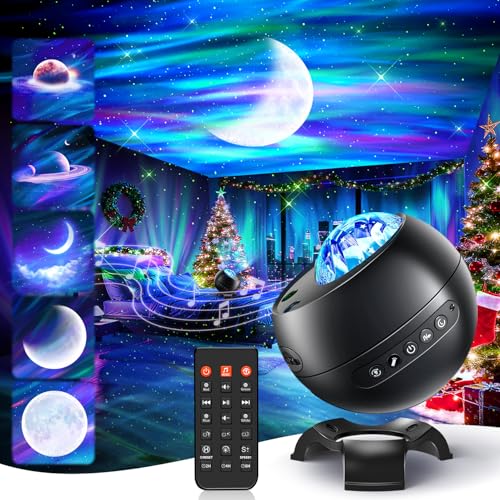
Many consumers research blue emissions because they use ambient novelty devices such as the HODANS Aurora Projector or the One Fire Galaxy Projector in nurseries and children’s rooms. These compact units project colorful clouds, wave ripples, and star fields across ceilings to help restless sleepers relax. Because these models run continuously near sleeping individuals, their spectral output deserves thoughtful consideration.
Most ambient star units allow users to select independent color channels using an included remote control. Setting a novelty projector to pure blue creates a bright, energetic atmosphere that may inadvertently keep young minds alert. Selecting warm color channels such as red, amber, or soft green avoids circadian disruption while maintaining a comforting, gentle nightlight presence on bedroom ceilings.
Using built-in auto-shutoff timers provides an excellent safety margin for bedroom installations. Most compact novelty units include timers that automatically power down the light source after one, two, or four hours. This feature allows children to fall asleep under calming ambient visuals without remaining exposed to continuous room illumination throughout deep sleep stages.
Practical Adjustments to Minimize Visual Fatigue
Adjusting software settings inside the projector’s on-screen menu offers direct control over visible spectrum output. Most home theater units feature dedicated picture presets, such as Cinema, Warm, or Natural modes, that calibrate the white point closer to industry-standard D65 mastering targets. These modes intentionally roll off harsh blue peaks in favor of balanced skin tones and cinematic warmth.
Applying structured viewing adjustments helps protect family eye comfort during long entertainment sessions:
- Switch the picture profile from Dynamic or Vivid mode to Warm or Movie mode.
- Enable Eco mode to lower lamp drive power and decrease overall spectral intensity.
- Position seating at a distance that lets viewers take in the entire screen comfortably.
- Incorporate low-intensity warm ambient lamps behind seating to soften room contrast.
- Avoid staring straight into the projection lens when walking near the beam path.
- Schedule periodic breaks during extended gaming sessions to relax focusing muscles.
Enabling low-power eco settings provides the added advantage of extending overall light source longevity. Reducing optical output lowers internal thermal loads, allowing cooling fans to run at reduced revolutions for quieter movie nights. These adjustments create a comfortable viewing environment that reduces eye fatigue while keeping operating temperatures stable.
Screen Materials and Surface Reflection Dynamics
The physical screen fabric you project upon plays a measurable role in how light bounces toward your seating area. Standard matte white screens feature a gain rating near 1.0, reflecting light evenly across a wide viewing cone. This uniform dispersion prevents hot-spotting, ensuring that short-wavelength energy scatters smoothly without creating intense glare spots directly in front of the viewer.
Ambient light rejecting screens use specialized optical layers or micro-ridges to direct projector illumination toward viewers while absorbing stray room light. While these screens provide outstanding contrast in bright family rooms, high-gain fabrics can concentrate light reflections along the optical center. Choosing a screen with balanced gain characteristics ensures comfortable viewing angles without harsh directional reflection.
Projecting directly onto a painted drywall surface also scatters light naturally, provided the paint features a flat or eggshell finish. High-gloss wall paints should be avoided because glossy surfaces act like mirrors, creating specular reflections that bounce concentrated light beams directly into the eyes. A proper matte finish preserves the diffuse reflection characteristics that make projection inherently gentle on visual systems.
Projectors naturally produce blue light to render accurate full-color imagery, but their indirect reflective delivery makes them far gentler on human eyes than direct-view screens. Setting your display to warm color presets, utilizing eco power modes, and maintaining soft ambient room lighting allows you to enjoy immersive big-screen entertainment while minimizing eye strain and supporting healthy evening sleep routines.
About the author
Lumens, lamp life, fan noise, and eye comfort are where projector marketing gets slippery. I write about what brightness ratings actually promise, how long light sources really last, why a unit gets loud or hot, and how to set up a picture that is comfortable to watch. When something stops working I focus on the practical checks first. My notes follow the site's review methods: research-based comparison, not lab testing.