
Best Ambient Light Rejecting Smart Projector Screens
Best ambient light rejecting smart projector screens for UST and standard throw setups, with practical guidance for November 2026.
 By Priya Raman
Published

Introduction
A bright room can make projected images look washed out, but an ambient-light-rejecting screen only works as intended when its surface matches the projector and placement. Screen size, viewing distance, aspect ratio, gain, and seating position all affect the result, so your projector’s throw type should guide the shortlist. These best ambient light rejecting smart projector screens include a 100-inch fixed-frame UST model, a customizable standard-throw material, and a 150-inch floor-rising option.
The ALR Screen for UST Projector uses a 16:9, 100-inch surface measuring 87.17 by 49.02 inches, with 0.8 gain and a wall-mounted aluminum frame. The SilverMagic material is also 100 inches and 16:9, but it is intended for standard-throw projectors rather than UST models. IN&VI offers a larger 150-inch format with 0.6 gain, motorized floor-rising operation, and a listed 170-degree viewing angle. Buyers comparing fixed installation with retractable storage may also benefit from this guide to fixed-frame projector screens and this overview of mobile projector screen formats.
| Award | Product | Best Projector Reviews Score About Best Projector Reviews ScoreBest Projector Reviews Score is a comparison aid based on available product information, not a hands-on testing result. Read our review methods. | |
|---|---|---|---|
| Best Overall |
 ALR Screen for UST Projector |
9.2/10 | Buy |
| Best Budget |
 ALR Projector Screen Material for Standard Throw |
8.8/10 | Buy |
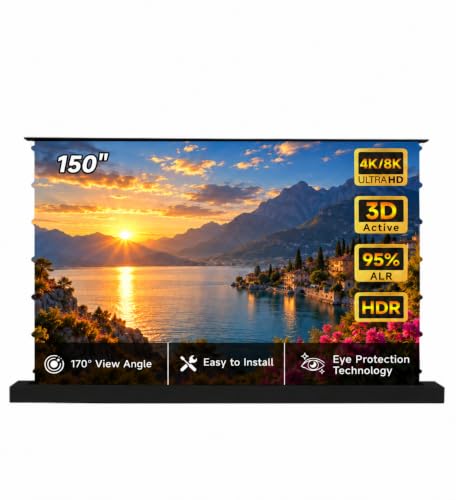 IN&VI 150" CLR ALR Motorized Projector Screen |
8.4/10 | Buy |
FAQs
Which screen suits an ultra-short-throw projector?
The ALR Screen for UST Projector and the IN&VI 150″ CLR ALR Motorized Projector Screen are the supplied UST-focused options. The SilverMagic material is specifically marked for standard-throw projectors, not UST models. Check the projector manufacturer’s throw and compatibility guidance before ordering.
Are these screens suitable for a bright room?
Yes, ALR surfaces are intended to reduce the effect of some ambient light, but they can’t guarantee the same result in every room. The listed products describe light-rejecting structures, while the projector’s brightness, light direction, placement, and room layout still matter. Direct light on the screen may remain distracting.
What is the difference between the fixed-frame and motorized options?
The ALR Screen for UST Projector uses a wall-mounted fixed frame with dual-frame construction and adaptive spring tensioning. IN&VI uses a floor-rising motorized design that retracts for storage and does not require wall drilling according to the listing. A fixed frame may suit a dedicated viewing position, while a retractable format may help in a shared or rented room.
How should screen gain affect the buying decision?
Screen gain describes how strongly the surface reflects projected light toward viewers. The supplied options list 0.8 gain for the UST fixed frame, up to 2.7X gain for the SilverMagic material, and 0.6 gain for IN&VI. Higher or lower gain can suit different projector output and seating arrangements, so consider viewing angle and center-seat placement rather than gain alone. For broader screen-planning context, see this guide to projector screen considerations.
Do all three screens use a 16:9 aspect ratio?
No, the supplied details explicitly identify 16:9 for the ALR Screen for UST Projector and the SilverMagic material. The IN&VI listing provides a 150-inch diagonal size but does not state an aspect ratio in the supplied information. Match the screen shape to your projector and primary source content before installation.
Can the screens work for classrooms or conference rooms?
Potentially, the first product listing names offices, conference rooms, and classrooms as possible applications. The fixed-frame design requires a suitable wall installation, while the IN&VI floor-rising format may help where wall drilling is undesirable. Room lighting, projector compatibility, screen placement, and storage needs should determine the final choice.
About the author
A good screen can change a picture more than a small projector upgrade, and it is the part many buyers skip. I write about screen materials, gain, ambient light rejecting designs, and how room lighting, wall color, and seating position change what you see. I try to keep the advice grounded in what a normal room looks like, not an ideal one. My notes follow the site's review methods: research-based comparison, not lab testing.