How Does a Holographic Projector Work? What You Need to Know
A clear answer to how does a holographic projector work, from spinning LED fans to film-slide night lights and true holograms. Updated October 2026.
 By Hannah Lindqvist
Updated

A product page promises a floating 3D image, but the thing in the photo looks like a flat pattern on a ceiling. That gap between the name and the result is the first thing to understand about holographic projectors. If you’re trying to work out how does a holographic projector work, the answer depends on which kind of device you mean, because the label gets attached to very different hardware.
Most consumer devices sold as holographic fall into two groups: spinning LED fan displays that trick the eye into seeing floating graphics, and film-slide night lights that cast stars or ocean scenes onto a wall. Neither is a true laser hologram in the scientific sense, which is recorded and replayed in a different way. This guide explains the principle behind each type, using the product listings and general optics as a guide rather than hands-on testing. It also covers what makes the picture look better, where the marketing language gets slippery, and how to match a device to the job you have in mind.
| Award | Product | Best Projector Reviews Score About Best Projector Reviews ScoreBest Projector Reviews Score is a comparison aid based on available product information, not a hands-on testing result. Read our review methods. | |
|---|---|---|---|
| Best Overall |
 2027 Upgraded Galaxy & Ocean Projector with 24 |
9.2/10 | Buy |
| Best Premium |
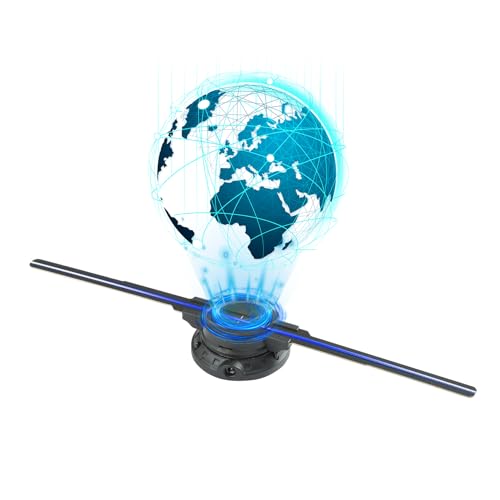 Missyou 19.7 Inch 3DHologramFan Holographic |
8.9/10 | Buy |
| Best Budget |
 5D Holographic Galaxy Projector Star Night Light |
Buy | |
 Dynamic 5D Holographic Galaxy Projector |
Buy |
How Holographic Projectors Work, and What the Name Usually Means
A holographic projector either builds an image from light that is recorded and replayed with interference patterns, tricks your eyes with fast-moving lights, or simply shines a pattern through a slide. Only the first of those is a true hologram, but the second and third are what most shoppers actually find on retail sites. Knowing which one a product uses tells you what it can show, where it works, and how much to expect from it.
What a True Hologram Does Differently
A real hologram records how light waves bounce off an object, not just a flat picture of it. The recording captures an interference pattern, which is created when a coherent light source such as a laser is split and recombined. When that pattern is lit again in the right way, it reconstructs the light the object originally gave off, and your eyes see depth and changing perspective as you move.
That process needs specialized equipment and a stable setup, which is why true holograms show up in museums, security features, and labs rather than in budget gadgets. A flat projector, TV, or night light has no recorded wavefront to replay, so it can’t produce the same effect. When a listing uses the word holographic, it is usually describing the look it is trying to evoke, not the physics behind it.
That distinction matters for expectations. A genuine hologram changes as you walk around it, while a flat or fan-based image stays tied to the display. The sections below describe what the two common consumer approaches really do.
Spinning LED Fans and the Trick of Persistence of Vision
The device in the data that most closely fits the floating-display idea is the Missyou 19.7 Inch 3DHologramFan Holographic. Its listing calls it a 3D hologram fan with an LED display, a transparent protective cover, and a rotating fan area. That wording points to the standard design for this category: a set of LED strips on blades that spin fast enough for your eyes to blend the lights into one image.
The effect relies on persistence of vision. Your eye holds onto a bright point for a fraction of a second, so lights that sweep around quickly appear as a continuous picture. Because the spinning blades are mostly empty space, the image seems to float in the air, and dark areas of the video simply show nothing.
That also explains why content for these fans is usually designed on a black background with bright objects. A full-frame bright video would fight with the gaps between the blades and look washed out. The listing says the unit comes with a large video library and supports content updates through a WiFi app, so the quality of the visuals will depend heavily on how the clips are designed.
Film-Slide Night Lights Sold as 5D Holographic
The other listings are galaxy and ocean night lights, and they work in a completely different way. A light source, usually an LED, shines through a small film or slide and a lens, which enlarges the pattern and throws it onto a ceiling or wall. The result is a flat projection of stars, waves, or aurora shapes, not a floating 3D object.
The VEYORRA galaxy and ocean projector listing is a good example. Its listing describes interchangeable films, touch control for scene switching and brightness, USB power, and a gooseneck that is adjusted by hand. It states that the projected image does not auto-rotate, which is a useful clarification for anyone expecting a moving scene.
The “5D” and “holographic” in those names are marketing terms, not technical specifications. There is no standard definition of five dimensions in this kind of product, and the listing does not explain it. Treat these devices as mood lighting, which is what the listings themselves describe, and they make sense; treat them as a hologram generator and they will disappoint. If a product page shows a figure floating in mid-air, look closely at whether the photo is a render or a real photograph of the device in use.
Listings With Little Detail
The 5D Holographic Galaxy Projector Star Night Light and the Dynamic 5D Holographic Galaxy Projector arrive with titles but no feature lists in the data. From the titles alone, they are USB-powered night lights with interchangeable films, adjustable direction, and, for one, a touch switch. That is the same basic design as the listing above, but the information doesn’t support claims about brightness, coverage, or build quality.
When a listing has this little information, it’s smart to check the full page before you buy. Look for the film count, how the film changes, how the light head moves, and what power source it needs. A product that can’t tell you those basics is harder to judge.
What Controls Image Quality in Each Type
For a fan display, the room matters most. These units tend to look best in dim to moderately lit interiors, because the image is made of lights and not of a surface that reflects them. Direct sunlight or strong overhead lighting can wash out the effect, so a shop window with heavy glare can be a poor home for one.
Viewing angle and distance also play a part. The picture is only convincing from the side the blades face, and the fan housing or protective cover can reflect nearby light. Placing the unit at eye level against a dark backdrop usually helps, but the listing doesn’t give a measured viewing range, so test it in your own space.
For a film-slide light, the surface is what you see. A flat, pale wall or ceiling gives a cleaner scene than a textured one, and a dark room makes the pattern stand out. The Galaxy listing says its wide-angle lens covers a room area of roughly ten to forty square meters, which is a manufacturer claim, so treat it as a rough guide, not a promise.
Content, Connectivity, and Control
The fan listing mentions WiFi app control for uploading and adjusting videos, Bluetooth audio pairing, and a remote. That mix suggests content can be swapped without opening the unit, and that sound can come from a connected speaker. App stability, supported file types, and account requirements aren’t described, so read the full product page or manual before counting on them.
The night lights are simpler. They run on USB power, so they work with a wall adapter, a power bank, a laptop port, or a car charger according to the Galaxy listing. Changing the scene means swapping a film or touching a button, with no app or Wi-Fi involved.
If you plan to display your own graphics on a fan, ask how the content must be formatted and whether the supplied library is licensed for commercial use. Video designed for a regular rectangular screen often needs adjusting to look right on a rotating display. That is a content question, not a hardware one, but it affects whether the display delivers what you imagine.
Safety and Placement
A spinning display needs a stable surface, and the blades should never be touched while moving. The Missyou listing says a transparent protective cover reduces direct contact with the rotating area, which is a sensible feature in public spaces, but it doesn’t remove the need to keep fingers, hair, and loose items clear. Mount or place it where children and passersby can’t bump it. A display that sits at the edge of a counter, or on a table that wobbles, is more likely to be knocked than one on a steady stand.
For wall or ceiling mounting, use hardware rated for the unit’s weight and follow the manufacturer’s instructions. If you need to hang a fan display above head height, consider asking a qualified installer. Keep vents and cables clear, and don’t operate any of these devices in the rain or near water.
Night lights are low-risk by comparison, but they still need ventilation and a stable base. Avoid covering them with fabric, and unplug them when you’re not around, particularly in a child’s room. Follow whatever age or use guidance the manufacturer provides.
Choosing by Purpose, Not by the Name
Start with what you want to see. If you want a floating promotional graphic for a shop, event, or reception desk, a fan-style display is the closer match, and the questions to ask are about content updates, cover design, and mounting. If you want a soft star field above a bed, a film-slide night light fits, and the questions are about film variety, power options, and brightness controls.
If you want a real video projector for movies or presentations, none of the listings here fit that job, since they describe neither a native resolution nor an ANSI lumens rating. A holographic label is not a substitute for a clear brightness rating, a throw ratio, or a stated resolution. When those figures are missing, treat the claim with caution.
The simplest way to answer how a holographic projector works is to ask what sits behind the label. A recorded light pattern is a hologram, a spinning LED array is a persistence-of-vision display, and a lit slide is a patterned light. Once you know which one you’re buying, the rest of the decision, from room light to placement, gets much easier.
About the author
Outdoor viewing is its own problem: stray light, wind, bugs, and neighbors. I write about what makes a backyard movie night work, from how many lumens the evening really asks for to screen choice, placement, and sound. I look for practical answers over marketing language and I flag claims that only make sense in a dark basement. My notes follow the site's review methods: research-based comparison, not lab testing.